IV Rank and IV Percentile: Knowing When to Sell Premium
IV Rank and IV Percentile: Knowing When to Sell Premium
Selling options in a low-IV environment is like running a car wash in the desert. The service is available, but nobody needs it, and you can barely charge anything for it. Selling the same service after a rainstorm? Different story.
Implied volatility is cyclical. It spikes during fear events and compresses during calm periods. Options sellers who enter trades at random times often find premiums too thin to justify the risk. Those who wait for elevated IV consistently find themselves on the right side of the vega trade — collecting inflated premiums that are likely to mean-revert lower, adding a vega tailwind to their theta income.
IV Rank and IV Percentile are the two tools that answer the only question that matters before selling premium: is IV cheap or expensive right now?
The Problem with Looking at IV Alone
A stock’s implied volatility of “30%” tells you very little by itself.
Is 30% high for this stock? Maybe. MSFT typically trades around 20–25% IV, so 30% would be elevated. For TSLA, which routinely sees 50–80% IV, a reading of 30% would be historically cheap.
Raw IV numbers are not comparable across stocks, and they’re not particularly informative even for a single stock unless you know where that reading sits within its historical context. That’s exactly what IVR and IVP tell you.
IV Rank (IVR): How High Is IV Right Now?
IV Rank (also called IVR) measures where current implied volatility sits within its 52-week range.
Formula: IVR = (Current IV − 52-week IV low) ÷ (52-week IV high − 52-week IV low) × 100
Example:
- 52-week IV low: 18%
- 52-week IV high: 72%
- Current IV: 45%
IVR = (45 − 18) ÷ (72 − 18) × 100 = 50
An IVR of 50 means current IV is exactly at the midpoint of its one-year range — moderate, neither cheap nor expensive.
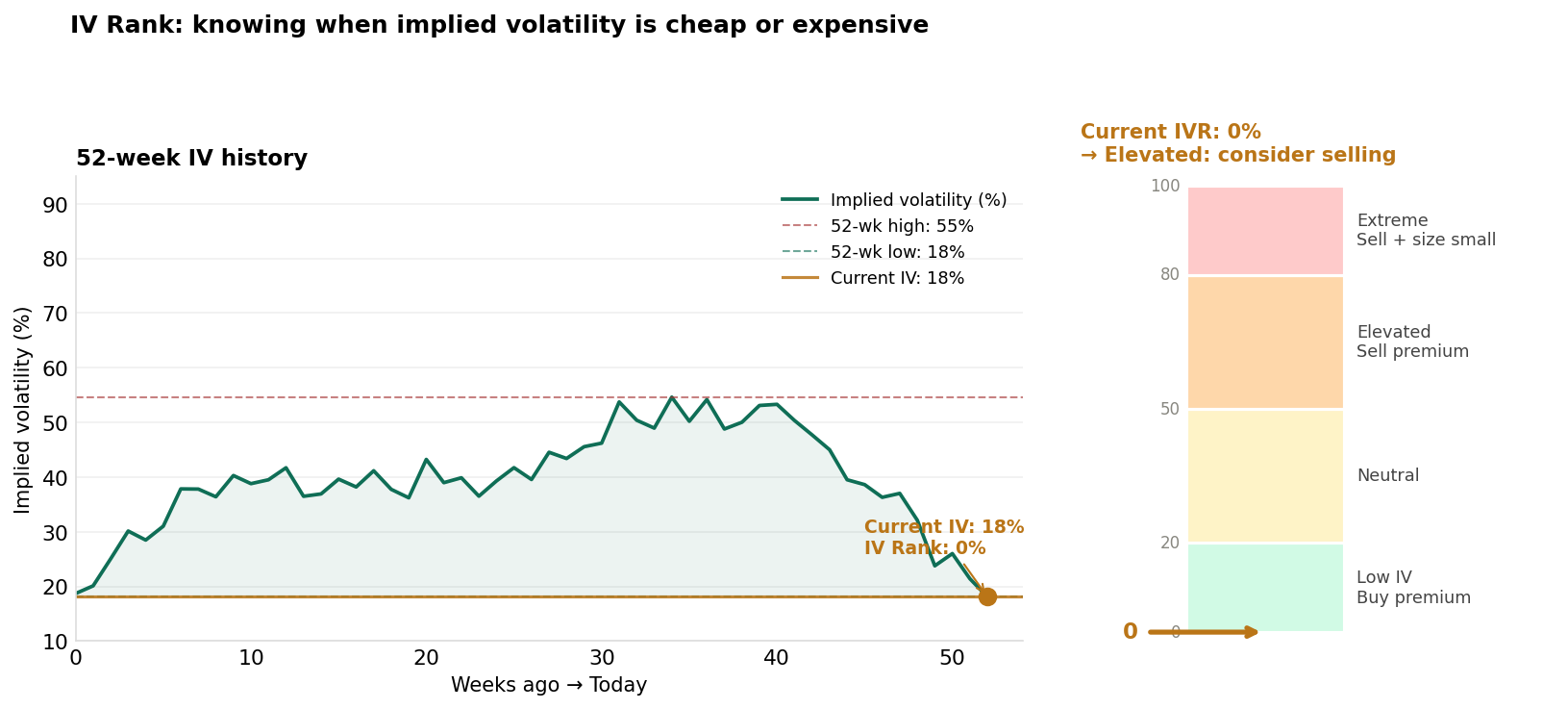 A stock’s 52-week IV history (left panel) with current IV marked. The IVR gauge (right panel) shows the current reading in context: low (sell options cautiously), elevated (strong sell signal), or extreme (sell but size small).
IV Percentile (IVP): How Often Has IV Been This Low?
IV Percentile takes a different approach: it counts how many days in the past year had lower IV than today.
Formula: IVP = (Days with IV below current IV) ÷ (Total days in lookback period) × 100
Example: If IV has been below today’s level on 310 of the past 365 days, IVP = 310/365 = 85%. This means today’s IV is higher than 85% of all observed readings in the past year — genuinely elevated.
IVR vs. IVP: What’s the Difference?
IVR tells you where current IV sits between the extremes (high and low). IVP tells you how often IV was below this level.
The difference matters when a stock has had one or two extreme IV spikes. A spike to 150% IV during a market crisis would set the 52-week high very high — making all subsequent “elevated” readings look moderate by IVR. IVP would still correctly flag those readings as elevated relative to the normal distribution.
| Metric | Formula | What It Captures | Sensitive to Extremes? |
|---|---|---|---|
| IV Rank (IVR) | (Current − Low) / (High − Low) | Position within range | Yes — one spike distorts the scale |
| IV Percentile (IVP) | % of days IV was lower | Distribution of all readings | No — counts all days equally |
In practice: Both metrics tell a similar story most of the time. IVP is slightly more robust; IVR is faster to calculate mentally. Use whichever your platform provides — or use both when they disagree.
Practical IV Rules for Premium Sellers
Most professional premium sellers use a tiered approach based on IVR:
| IVR Level | Interpretation | Suggested Action |
|---|---|---|
| 0–20 | Low IV: premiums are thin | Avoid selling premium; consider debit spreads or buying options |
| 20–40 | Below average | Trade conservatively; reduce position size |
| 40–60 | Moderate-to-elevated | Standard premium-selling conditions; normal sizing |
| 60–80 | High IV | Strong environment for selling premium; wider strikes possible |
| 80–100 | Extreme IV | Best premium-selling premiums available; size small (gap risk) |
Note: IVR above 80 usually indicates a significant fear event — earnings miss, macro shock, or sector-specific news. While premiums are richest here, the underlying uncertainty is also highest. Sizing conservatively at extreme IVR protects against tail events that justify the elevated IV in the first place.
How IV Rank Affects Your Trade Construction
IVR doesn’t just tell you whether to trade — it affects how you trade.
In elevated IV (IVR > 50):
- Premiums are fatter for the same strike and DTE
- You can sell strikes further OTM (lower delta) for the same premium
- Wider iron condor wings are achievable with acceptable credit
- The vega headwind (you’re short vega) becomes a tailwind as IV reverts lower
In compressed IV (IVR < 30):
- Premiums shrink — you need to go closer to ATM (higher delta) for meaningful income
- Higher delta means lower probability of success and more directional exposure
- A small stock move has a larger P&L impact on your position
- Vega is working against you (you’re short in a potentially rising-IV environment)
This is why the same strategy can be a strong trade in October and a poor trade in June — the market’s volatility environment changed, even if the stock didn’t.
Finding IV Rank on Your Platform
Most major brokerage platforms display IVR/IVP in the options chain or trade analysis screens:
- Thinkorswim (TD Ameritrade/Schwab): “IV Percentile” column in the Watchlist or Market Watch
- Tasty Trade / Tastylive: IVR displayed prominently on every stock page
- Interactive Brokers: Available in the Options Analytics tool
- Webull/Robinhood: Limited — may need to calculate manually or use a screener
Many traders maintain a simple spreadsheet tracking IVR weekly for their regular trading universe (SPY, QQQ, AAPL, NVDA, etc.) to develop intuition for each stock’s “home base.”
A Practical Workflow
Before entering any premium-selling trade, run this quick check:
- Pull up IV Rank for the underlying you’re considering
- Is IVR above 40? If yes, conditions are acceptable for selling. If no, ask whether a debit trade makes more sense
- Is IVR above 80? Size the position at 50% of normal to account for gap risk
- Is a known catalyst upcoming? If IV is elevated because of an earnings event, decide whether you want IV crush exposure or want to wait until after
- What’s the VIX doing? If VIX is above 25, most individual stock IVs are elevated. This can be an environment-wide selling opportunity — or a sign of genuine market stress
Key Takeaways
- IV Rank (IVR) = where current IV sits in its 52-week range; 0 = all-time-low, 100 = all-time-high
- IV Percentile (IVP) = what % of past-year days had lower IV; more robust to extreme historical spikes
- Both measure the same thing: whether today’s option premiums are cheap or expensive in historical context
- Sell premium when IVR > 40–50%; buy premium when IVR < 20–30%
- Elevated IVR gives you richer premiums AND a vega tailwind as IV mean-reverts lower after you enter
- Extreme IVR (80+) = richest premiums, but size small — extreme IV reflects real risk
What’s Next
Sometimes direction matters — you want to express a view on where a stock is going while keeping risk defined. Debit Spreads: Directional Bets with Built-In Protection walks through bull call and bear put spreads for when you have a directional conviction but don’t want the full cost of buying an outright option.
Tastytrade surfaces IV rank and IV percentile directly on their watchlist and options chain — so you can scan for high-IV opportunities across your entire watchlist and immediately know whether conditions are favorable for selling premium before you even open the chain.
Disclosure: this is a referral link. If you sign up via this link, the site may earn a commission at no cost to you.
Disclaimer: This content is for educational and informational purposes only and does not constitute financial, investment, or trading advice. Options trading involves significant risk and is not suitable for all investors. You may lose the entire amount invested. Always conduct your own research and consult a licensed financial advisor before making investment decisions.