Tactical Trade Management: How to 'Roll' an Options Position for Credit or Time
In the world of professional options trading, very few positions are simply opened on day one and then held blindly, untouched, until expiration day. Financial markets are incredibly dynamic, stock prices swing, and your fundamental outlook on a stock can change rapidly. This is exactly where active tactical trade management comes into play, and the single most versatile, powerful technique in your arsenal will be rolling an options position.
Rolling an option contract simply involves closing an existing, live options position (or an entire spread) and simultaneously opening a brand new one, typically with a different expiration date, a different strike price, or both. It’s a calculated way to mechanically adjust your trade, strategically collect more upfront premium, or give a struggling position more time to become profitable, without completely abandoning your original thesis.
Why Roll an Options Position? The Power of Adjustment
There are several highly strategic reasons why expert traders actively choose to roll their options:
- To Collect Additional Credit (Income Generation): If a short option (or a credit spread) is doing exceptionally well and rapidly moving towards peak profitability, but still has some time left on the clock, you might choose to roll it further out in time. This allows you to collect even more premium, compounding your profit potential.
- To Defend a Losing Position (Risk Mitigation): If a short option is aggressively being challenged (the stock price is moving rapidly towards or past your chosen strike), you can almost always roll it further out in time and/or adjust the strike price further away. This critically reduces immediate risk, drastically improves your break-even point, and prevents a total loss.
- To Extend Time (For Long Options): If a long option position is fundamentally still viable and your thesis holds, but the stock simply needs more time to make its anticipated move, you can defensively roll it to a later expiration date to avoid imminent Theta decay.
- To Adjust Directional Bias: If your overarching outlook on the stock has shifted slightly based on new data, you can dynamically roll to completely different strikes to shift your profit/loss probability zones.
The Mechanics of Rolling: “Out,” “Up,” and “Down”
Rolling always fundamentally involves two distinct parts executed in a single sequence: a closing transaction (to exit the old trade) and an opening transaction (to enter the new one). Most modern brokers allow these to be executed effortlessly as a single, combined “roll” order. Tastytrade is one such platform that offers intuitive multi-leg order entry, making it simple to roll positions out, up, or down in a single click.
1. Rolling “Out” (Extending Time)
This is unequivocally the most common type of defensive and offensive roll. You close your current position and immediately open a new one with a later expiration date, usually completely maintaining the exact same strike price.
- When to use:
- Selling Options: If your short option is profitable but you want to continue the income stream, or if it’s currently being challenged and you desperately want to give the stock more time to reverse and move away from your strike. You almost always aim to roll for a net credit (getting paid to extend).
- Buying Options: If your long option is still in contention but desperately needs more time to reach its target before Theta destroys it. You usually have to roll for a net debit (paying more premium for the luxury of extra time).
- Example (Selling Puts): You sold the XYZ $50 Put expiring in 30 days for a $1.00 credit. XYZ stock falls to $52.00, and the $50 Put is now worth $0.20. You decide to roll:
- Buy to Close the XYZ $50 Put (30 days) for $0.20.
- Sell to Open the XYZ $50 Put (60 days) for $0.70.
- Net Result: You immediately collect an additional $0.50 net credit ($0.70 – $0.20), effectively extending the trade for another 30 days while lowering your true break-even price.
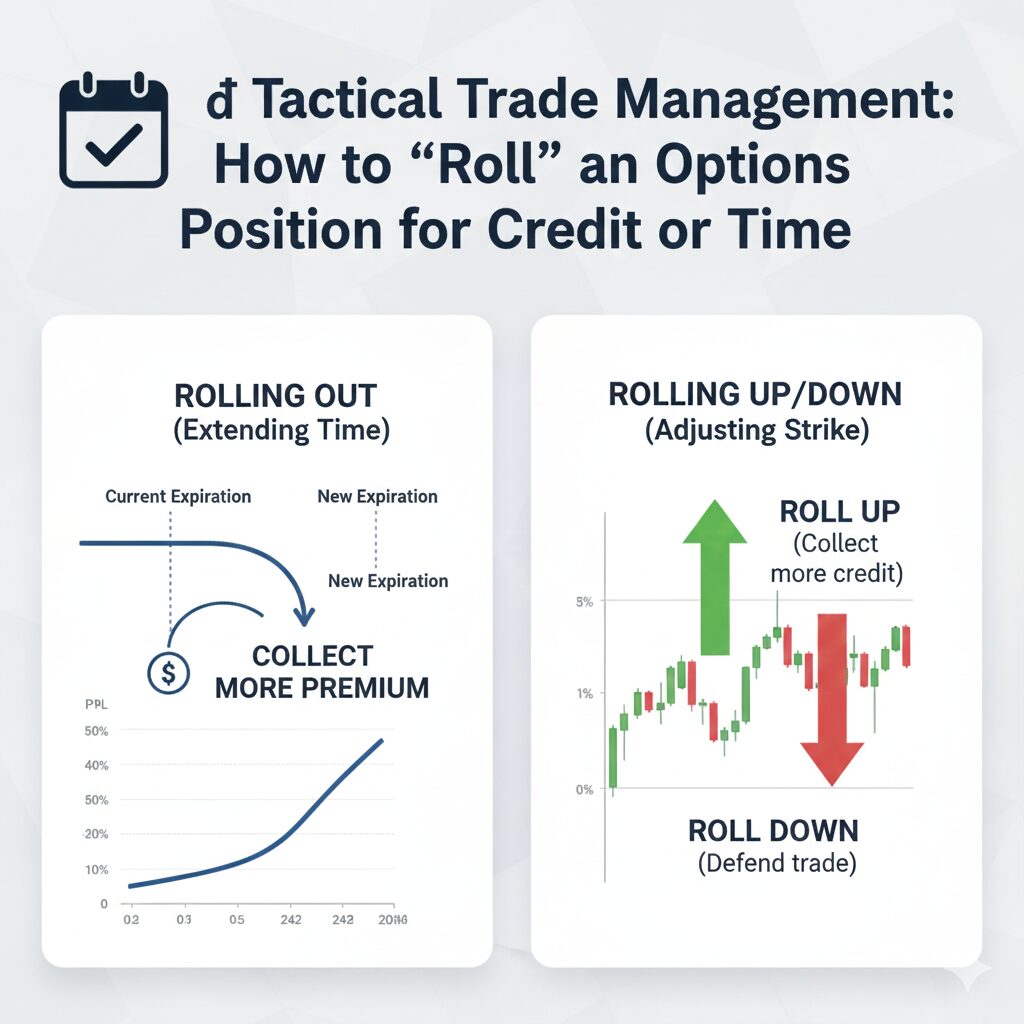
2. Rolling “Up” and “Down” (Adjusting Strikes)
This specific roll involves intentionally changing the strike price, usually while keeping the exact same expiration date.
- Rolling “Up” (Higher Strike): If you are actively short an option (like selling puts) and the stock has violently rallied upward, you can dynamically roll your short put strike up (closer to the new stock price). This allows you to take on a slightly riskier position for a significantly larger credit, as the market is paying you much more for the increased risk exposure.
- Rolling “Down” (Lower Strike): If you are short a call and the stock has completely cratered, you can confidently roll your short call strike down (closer to the new stock price) to take in significantly more premium.
When to use Rolling Up or Down
This tactic is predominantly used when you want to realize an immediate gain on your initial position while simultaneously deploying capital into a new, more profitable, or better-positioned trade at the exact same time horizon.
3. Rolling “Up/Down and Out” (The Defensive Roll)
This is the absolute most critical defensive tactic used to manage a deeply threatened position. It aggressively combines the two methods above.
When a stock moves sharply and dangerously against your short option (e.g., your short put is heavily threatened because the stock is falling rapidly into your strike), you need to forcefully push the risk further out in time and further away from the current, dangerous price.
- Defensive Roll Example (Bull Put Spread is challenged):
- The stock drastically falls and your once-safe Bull Put Spread is suddenly In-The-Money (ITM) and showing a loss.
- Action: You instantly Buy to Close your challenged, losing spread and simultaneously Sell to Open a brand new spread with a later expiration date (Out) and much lower strikes (Down).
- Goal: To aggressively push the break-even point significantly lower and give the trade drastically more time to recover, ideally by collecting a small net credit to offset the time decay and risk adjustment.
The mathematical ability to successfully roll a challenged position for a net credit—even when the underlying stock is moving violently against you—is a true hallmark of an advanced, profitable trader, as it literally turns a potential devastating loss into a highly manageable extension.
4. Key Considerations Before Rolling
Rolling is incredibly powerful, but it is not free magic; it carries distinct costs and risks you must acknowledge:
- Transaction Costs: Every single roll is inherently two transactions (close + open), meaning you pay double the commissions and exchange fees.
- Wider Bid/Ask Spreads: If the option contract you are frantically trying to close or open has notoriously low liquidity, the excessively wide bid/ask spread can make the roll financially costly, heavily eating into your potential credit or worsening your debit.
- Increased Duration Risk: Rolling out in time inherently ties up your trading capital and margin requirements for a much longer period. While you gain more time to be right, you are continuously exposed to black swan market events for far longer.
Expert Tip: As a rigorous general rule for professional premium sellers, you should aggressively manage (and definitively roll) any threatened short option or credit spread the moment it reaches a loss of 50% to 100% of the original credit received, especially if there are still more than 21 days remaining until expiration. Never wait until the final week or expiration day! Time is your ultimate leverage when rolling.