Vertical Spreads: Mastering Defined-Risk Strategies with Call and Put Spreads
Vertical spreads are fundamental to options trading beyond basic buying and selling. They represent a significant step in managing risk and creating more nuanced directional or neutral bets. In essence, a spread involves simultaneously buying one option and selling another option of the same type (both calls or both puts) with the same expiration date, but different strike prices. The vertical distance between these strike prices is what defines your risk and reward.
The power of vertical spreads lies in their ability to:
- Define Maximum Risk: You know your absolute worst-case scenario upfront before entering the trade.
- Reduce Capital Outlay: Compared to outright long options, debit spreads are significantly cheaper. Compared to naked options, credit spreads require far less margin and capital.
- Target Specific Price Ranges: You can craft precision trades for bullish, bearish, or neutral outlooks.
Let’s break down the four main types of vertical spreads.
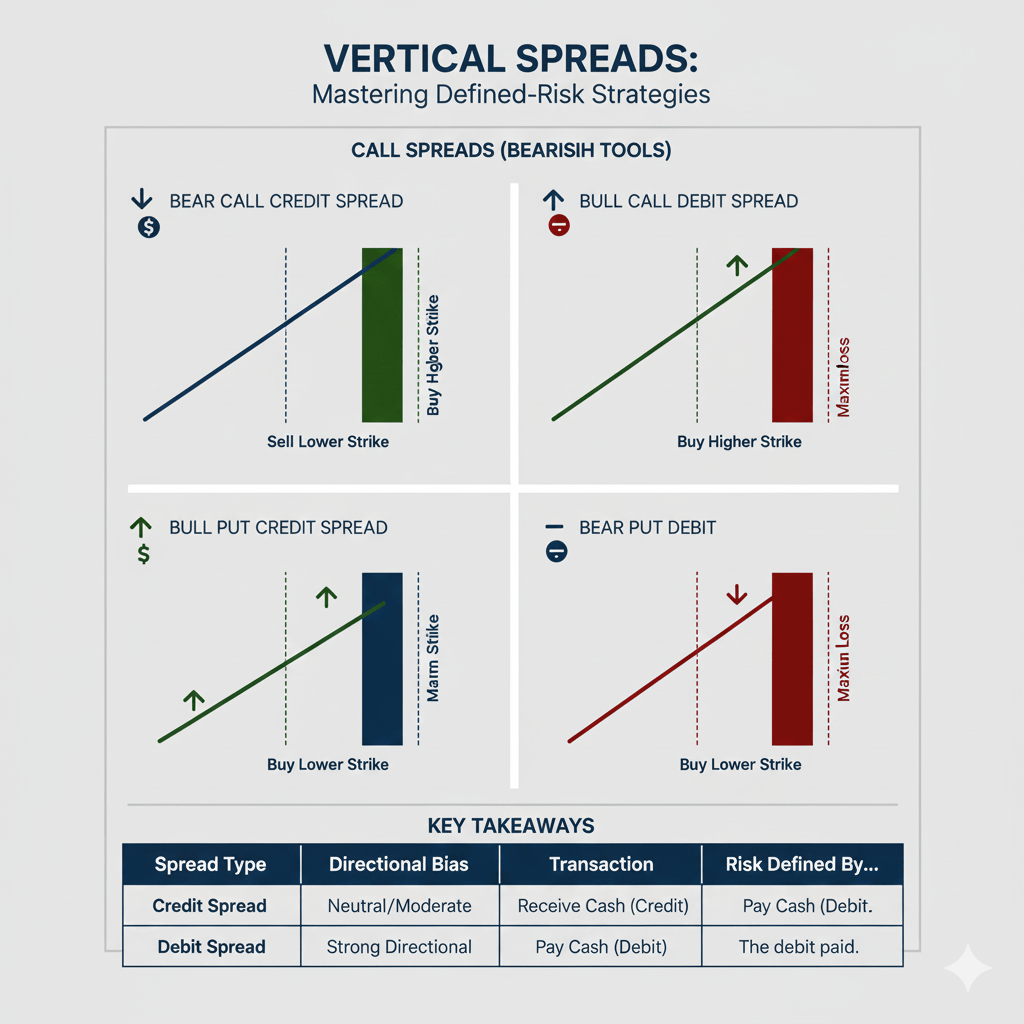
Part 1: The Call Spread (Your Bearish/Bullish Tools)
A Call Spread involves trading two call options. Depending on whether you are buying or selling the spread, it can be a bullish or bearish play.
1. The Bear Call Credit Spread (Selling Premium)
This is a classic income trade, used when you are moderately bearish or neutral, and expect the stock price to stay below a certain ceiling.
- Setup: Sell a lower-strike Call (to collect the bulk of the premium) and Buy a higher-strike Call (to define risk).
- Goal: For the stock price to finish below the short strike so all options expire worthless. You profit by keeping the net credit received upfront.
- Risk/Reward:
- Max Profit: The net credit received.
- Max Loss: The difference between the strikes minus the credit received.
This spread is often executed when Implied Volatility (IV) is high, making the options expensive to sell. It forms the “roof” of the popular Iron Condor strategy.
2. The Bull Call Debit Spread (Buying for Upside)
Used when you are strongly bullish but want to cap your risk and significantly reduce the cost of an outright long call.
- Setup: Buy a lower-strike Call and Sell a higher-strike Call.
- Goal: For the stock price to finish above the high strike to maximize the difference between the option values.
- Risk/Reward:
- Max Profit: The difference between the strikes minus the net debit paid.
- Max Loss: The net debit paid (the cash you spent).
Part 2: The Put Spread (Your Bullish/Bearish Tools)
A Put Spread involves trading two put options. Like the call spread, it can be structured for a bullish or bearish market view.
1. The Bull Put Credit Spread (Selling Premium)
This is one of the most popular income strategies, used when you are moderately bullish or neutral, betting the stock price will stay above a certain floor.
- Setup: Sell a higher-strike Put (to collect premium) and Buy a lower-strike Put (to define risk).
- Goal: For the stock price to finish above the short strike so all options expire worthless. You keep the initial credit received.
- Risk/Reward:
- Max Profit: The net credit received.
- Max Loss: The difference between the strikes minus the credit received.
This is a key component of the Iron Condor, forming the “floor,” and is highly favored because broad market stock indices generally drift upward over time.
2. The Bear Put Debit Spread (Buying for Downside)
Used when you are strongly bearish and want a cheaper, defined-risk way to bet on the stock falling violently.
- Setup: Buy a higher-strike Put and Sell a lower-strike Put.
- Goal: For the stock price to finish below the low strike to maximize the difference between the option values.
- Risk/Reward:
- Max Profit: The difference between the strikes minus the net debit paid.
- Max Loss: The net debit paid.
Key Takeaways: Credit vs. Debit Spreads
Understanding the fundamental difference between paying for a trade (Debit) and getting paid for a trade (Credit) is the core of mastering vertical spreads.
| Spread Type | Directional Bias | Transaction | Profit if… | When to Use |
|---|---|---|---|---|
| Credit Spreads (Bear Call, Bull Put) | Neutral/Moderate | You Receive Cash (Credit) | Time passes and options decay (Theta). Stock stays away from short strike. | When options are Expensive (High IV). |
| Debit Spreads (Bull Call, Bear Put) | Strong Directional | You Pay Cash (Debit) | The stock moves quickly and options gain intrinsic value. | When options are Cheap (Low IV). |
Vertical spreads provide the flexibility to capitalize on almost any market outlook while ensuring you never take on catastrophic, undefined risk.
Now that you’re an expert at setting up defined-risk trades, the next step is learning how to manage them when the market doesn’t cooperate. Our next article will focus on the essential tactical skill of rolling a position to defend your capital and improve your probabilities.