Calls vs. Puts: The Plain-English Guide to Options Contracts
Calls vs. Puts: The Plain-English Guide to Options Contracts
Every options trade starts with one question: are you buying a call, selling a call, buying a put, or selling a put? Four combinations. Infinite strategies built from those four building blocks.
If that sentence made your eyes glaze over, don’t worry. By the end of this article, you’ll understand exactly what calls and puts are, when each makes sense, and how the two sides of every options trade interact. No jargon barriers — just plain English with real examples.
Start Here: What Is an Options Contract?
An options contract is an agreement that gives the buyer the right — but not the obligation — to buy or sell a stock at a specific price, on or before a specific date.
Two key words: right (not obligation) and price (not current market price — a pre-agreed price called the strike price).
The buyer of an option pays a premium for that right. The seller of an option receives that premium in exchange for taking on an obligation.
That’s the whole foundation. Everything else is a variation on this theme.
What Is a Call Option?
A call option gives the buyer the right to buy 100 shares of a stock at the strike price before expiration.
Think of it like a deposit on a house. Imagine you find a house worth $500,000. You pay the owner $5,000 today for the right to buy it at $500,000 within the next 90 days. If the house appreciates to $550,000, you exercise your right and profit. If it doesn’t, you lose your $5,000 deposit — but nothing more.
In options terms:
- The $500,000 is the strike price
- The $5,000 deposit is the premium
- The 90-day window is the expiration date
- Your right to buy is a call option
When do buyers profit? When the stock rises above the strike price by more than the premium paid. If you buy a $120 call for $5, you profit when the stock exceeds $125 at expiration.
When do sellers profit? When the stock stays below the strike. The seller collects the $5 premium and keeps it if the stock never reaches $120.
What Is a Put Option?
A put option gives the buyer the right to sell 100 shares at the strike price before expiration.
Think of it like an insurance policy. You own a car worth $20,000 and pay $500 for a policy that guarantees the insurance company will pay you $20,000 if the car is totaled. The insurance company hopes they never have to pay out — they just want the premium.
In options terms:
- The $20,000 is the strike price
- The $500 is the premium
- The insurance company is the put seller
- You are the put buyer
When do put buyers profit? When the stock falls below the strike price by more than the premium paid. A $120 put bought for $5 profits when the stock falls below $115.
When do put sellers profit? When the stock stays above the strike. The seller collects the premium and keeps it if the stock doesn’t fall to $120.
The Full Picture: Payoff at Expiration
Here’s what the profit and loss looks like for a long call and long put on the same $120 stock, each purchased for a $5 premium:
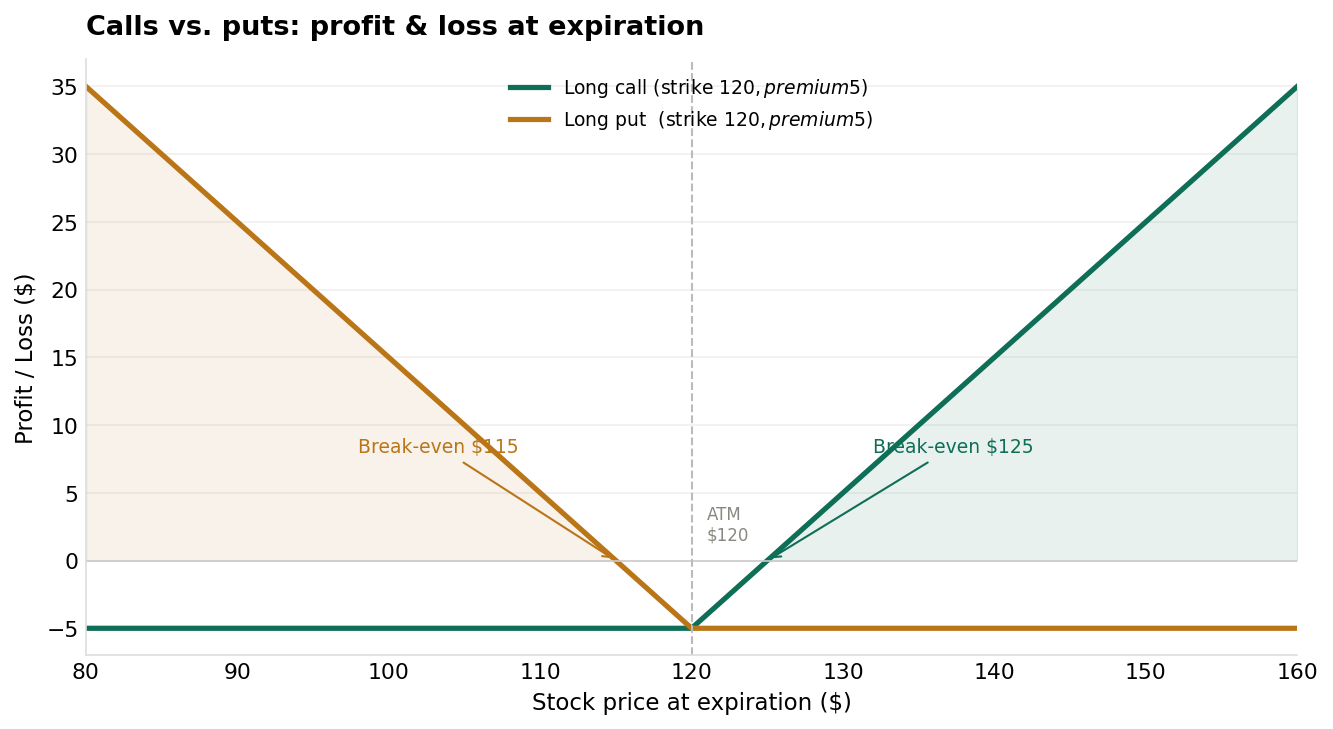 Long call profits above $125 (break-even); long put profits below $115 (break-even). Both have a maximum loss of $5 — the premium paid.
A few important things to notice:
- Both have defined, limited risk — the maximum you can lose is the premium paid ($5 per share = $500 per contract)
- Calls have unlimited upside — a stock can theoretically go to infinity
- Puts have substantial (but limited) downside — a stock can fall to zero, giving a maximum put profit of strike − premium
Buyers vs. Sellers: Who Has the Edge?
Here’s a counterintuitive truth: most options are never exercised. Most contracts are closed before expiration, not held to the end. Of those actually held to expiration, studies estimate roughly 30% expire worthless — a lower figure than the 70–80% often cited, which counts all opened contracts including those closed early. Either way, the implication is the same: buyers frequently pay for a right they won’t use, and systematic sellers collect that premium as income over time.
This means that on average, sellers of options have a statistical edge over buyers. The premium collected by sellers represents a real income stream over time, while buyers are paying for a right they often won’t use.
This is why much of this blog focuses on selling options — specifically, selling calls and puts strategically to collect premium. The buyer-seller asymmetry is the foundation of every income strategy we’ll discuss.
That said, buying options has its place: leveraged directional bets before earnings, portfolio protection (protective puts), and defined-risk speculation. We’ll cover those too.
Quick Reference: The Four Basic Positions
| Position | Right or Obligation | Direction | Max Gain | Max Loss |
|---|---|---|---|---|
| Buy a call | Right to buy | Bullish | Unlimited | Premium paid |
| Sell a call | Obligation to sell | Neutral / Bearish | Premium received | Unlimited* |
| Buy a put | Right to sell | Bearish | Strike − Premium | Premium paid |
| Sell a put | Obligation to buy | Neutral / Bullish | Premium received | Strike − Premium |
*Selling naked calls (without owning the stock) carries theoretically unlimited risk. Covered calls — where you own the stock — cap that risk.
One Contract = 100 Shares
This trips up a lot of beginners. Options contracts are almost always written for 100 shares. So when you see a call option priced at $5.00, the actual cost is $500 ($5.00 × 100). Always multiply by 100 when calculating position cost or potential gain.
Key Takeaways
- A call gives the buyer the right to purchase 100 shares at the strike price — profits when the stock rises
- A put gives the buyer the right to sell 100 shares at the strike price — profits when the stock falls
- Every option has a buyer and a seller; the seller receives premium and takes on an obligation
- Of options held to expiration, roughly 30% expire worthless — enough to give disciplined sellers a real statistical edge, especially when combined with active position management and early closes
- Always multiply the quoted premium by 100 to get the true dollar cost of a contract
What’s Next
Now that you understand the two sides of every option, it’s time to see them live in the market. Next up: Your First Options Chain: How to Read It — a full walkthrough of the numbers, columns, and color codes you’ll see on any brokerage platform.
When you’re ready to trade calls and puts with real money, Tastytrade is built for options traders from the ground up — with a clean interface that puts calls on the left, puts on the right, and premium front and center where it belongs.
Disclosure: this is a referral link. If you sign up via this link, the site may earn a commission at no cost to you.
Disclaimer: This content is for educational and informational purposes only and does not constitute financial, investment, or trading advice. Options trading involves significant risk and is not suitable for all investors. You may lose the entire amount invested. Always conduct your own research and consult a licensed financial advisor before making investment decisions.