The Covered Call: Generate Income from Stocks You Own
The Covered Call: Generate Income from Stocks You Own
If you own quality stocks in a range-bound market and aren’t selling covered calls, you may be leaving income on the table. The trade-off: you’ll cap your upside in strong rallies — a real cost in bull markets. That said, the covered call is the most widely used options strategy in the world — and for good reason. It turns a passive stock holding into an active income generator with minimal additional risk.
This is where most options traders start, and many never need to go much further.
What Is a Covered Call?
A covered call is selling someone else the right to buy your shares at a specific price before a specific date, in exchange for a cash premium paid to you today.
You are “covered” because you already own the 100 shares you might be obligated to deliver. This is what makes it one of the lowest-risk options strategies — there is no scenario where you lose more than you would have lost by simply holding the stock.
The trade in plain English:
- You own 100 shares of Stock X at $170
- You sell someone the right to buy those shares from you at $180 before the end of the month
- They pay you $5 per share ($500) for that right, right now, into your account
- If the stock stays below $180, they don’t exercise — you keep the shares AND the $500
- If the stock rises above $180, they exercise — you sell your shares at $180 and keep the $500
Either way, you collected $500.
The Full P&L Picture
Let’s build the trade precisely:
Setup:
- Own 100 shares of AAPL at $170 (cost basis: $170/share)
- Sell 1x AAPL $180 Call, expiring in 30 days
- Premium received: $5.00/share = $500 total, credited to your account immediately
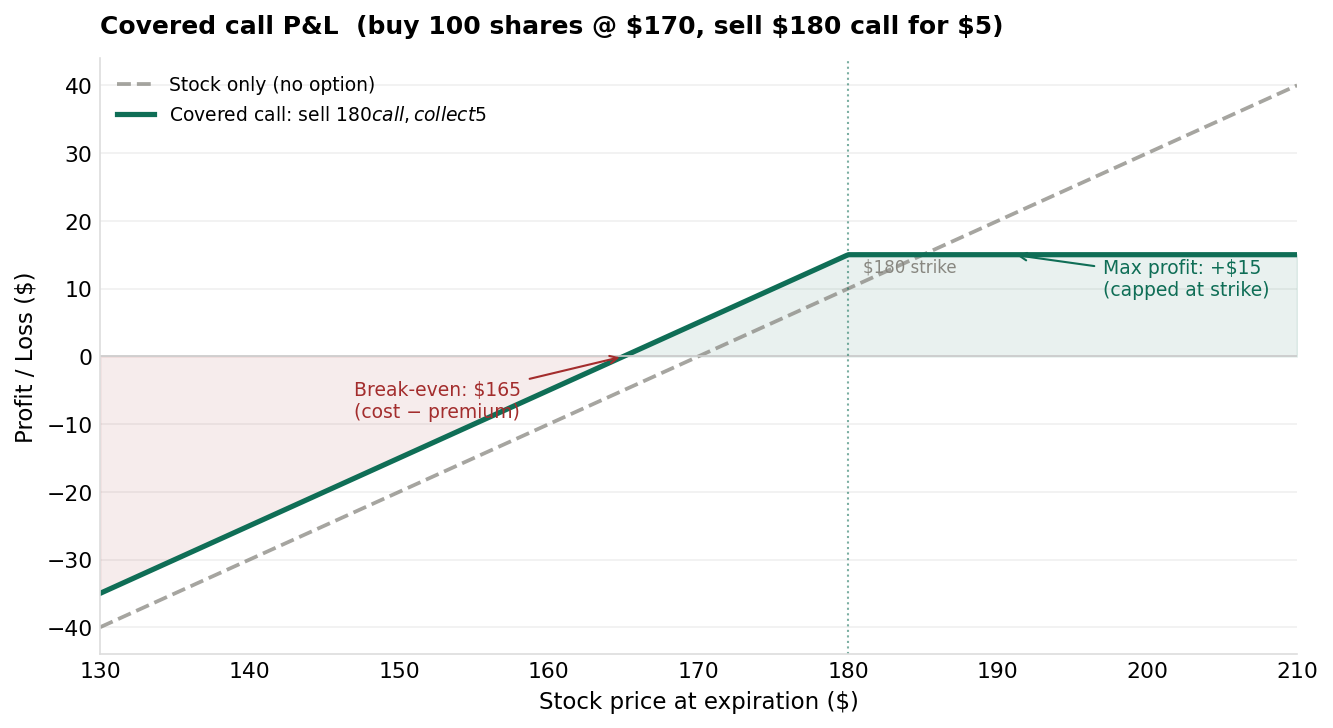 The covered call (teal) outperforms stock alone (dashed) below $175 and matches it exactly up to $180 — then caps out. The $5 premium permanently lowers the break-even from $170 to $165.
Outcomes at expiration:
| Scenario | Stock Price | P&L on Shares | Premium Kept | Total P&L |
|---|---|---|---|---|
| Stock falls hard | $150 | −$2,000 | +$500 | −$1,500 |
| Stock flat | $170 | $0 | +$500 | +$500 |
| Stock rises moderately | $178 | +$800 | +$500 | +$1,300 |
| Stock at strike | $180 | +$1,000 | +$500 | +$1,500 (max) |
| Stock surges past strike | $195 | Sold at $180 | +$500 | +$1,500 (capped) |
The maximum profit is $1,500 per contract ($15/share), achieved at any price at or above $180. The break-even is $165 — the $170 cost basis minus the $5 premium received.
Selecting the Right Strike
The most important decision in a covered call trade is strike selection. It involves a trade-off between premium income and upside retention.
Higher strike (further OTM): Less premium, but more room for the stock to run before you’re capped. Use when you expect moderate-to-strong appreciation.
Lower strike (closer to ATM): More premium, but you cap your upside sooner. Use when you expect the stock to be flat or drift sideways.
A practical starting point: target the 0.20–0.30 delta call, 30–45 DTE. For a $170 stock, this typically lands around $180–$185 depending on volatility.
Rule of thumb: if you’d be upset that the stock ran past your strike and your shares got called away, the strike is too close. Choose a strike you’d be happy selling your shares at.
When and Why Covered Calls Work
Covered calls are not for every market condition. They shine when:
- You expect the stock to be range-bound or slowly rising — the ideal environment for collecting premium without getting called away
- Volatility is elevated — higher IV means fatter premiums; the same trade yields more income
- You’re approaching a cost basis you’d be happy selling at — the covered call becomes part of a planned exit strategy
They underperform in strong uptrends. If you sell a $180 call and AAPL rips to $210, you’ve capped yourself at $180 while watching the stock trade $30 higher. This is the real cost of the strategy — capped upside. It’s not a risk per se, but it is a trade-off.
When Things Go Wrong: Managing a Covered Call
Scenario 1: Stock falls below your break-even
The call expires worthless (good — keep the premium), but your shares are now showing a loss. You have two choices:
- Sell another call at a lower strike to collect more premium and reduce your cost basis further
- Hold and wait for recovery if your thesis on the stock remains intact
Scenario 2: Stock surges well above your strike
Your shares get called away at $180 while the stock is at $195. You’ve missed $15/share of gains. Options:
- Roll the call up and out: Before expiration, buy back the $180 call and sell a higher-strike call in the next month. You pay a debit but extend your runway. See Rolling Options for the full framework.
- Accept the assignment if $180 was your planned exit price to begin with
Scenario 3: Stock trades at exactly your strike near expiration (Pin risk)
When a stock pins near your strike on expiration day, there’s uncertainty about whether the call will be exercised. Check with your broker — most will auto-exercise or auto-close ITM options, but you may need to take action.
The Covered Call as a Monthly Income System
The real power of covered calls is in repetition. Treat each expiration cycle as one iteration of a system:
- Own quality stocks you’re comfortable holding long-term
- Sell a 30-45 DTE covered call at the 0.20–0.30 delta strike
- Close at 50% profit (usually around 14–21 DTE)
- Sell the next month’s call immediately
Over 12 months, running this system on a stock that doesn’t get called away can generate 8–14% in annual premium income — on top of any dividends the stock pays.
Key Takeaways
- A covered call sells the right to buy your 100 shares at a chosen strike price in exchange for immediate cash premium
- Max profit = (Strike − Cost Basis + Premium) — achieved if the stock closes at or above the strike
- Break-even = Cost Basis − Premium — the $5 premium permanently lowers your risk floor
- Target 0.20–0.30 delta, 30–45 DTE for a balance of premium and probability
- The real cost is capped upside — choose strikes you’d genuinely be happy selling shares at
- Roll, extend, or accept assignment to manage positions that approach the strike
What’s Next
What if you want to buy a stock at a lower price and get paid to wait? That’s the other side of the income coin: Cash-Secured Puts: Getting Paid to Buy Stocks Cheaper.
Ready to sell your first covered call? Tastytrade makes it straightforward — their platform is built around defined-risk and income strategies like the covered call, with a streamlined order ticket that shows your max profit, break-even, and probability of profit before you place the trade.
Disclosure: this is a referral link. If you sign up via this link, the site may earn a commission at no cost to you.
Disclaimer: This content is for educational and informational purposes only and does not constitute financial, investment, or trading advice. Options trading involves significant risk and is not suitable for all investors. You may lose the entire amount invested. Always conduct your own research and consult a licensed financial advisor before making investment decisions.