Rolling Options: How to Adjust Positions That Go Against You
Rolling Options: How to Adjust Positions That Go Against You
No options strategy has a 100% win rate. Stocks don’t always behave. Markets gap overnight. An iron condor that was perfectly placed gets tested two weeks later when the Fed makes a surprise announcement. This is not a failure of strategy — it’s the nature of markets.
What separates profitable options traders from losing ones isn’t win rate. It’s what they do when a position is threatened. Rolling is the primary tool for adjusting live positions, extending time, and avoiding realized losses when a trade can still be salvaged.
But rolling can also be misused — a way to delay accepting a loss rather than intelligently extending a trade. This article covers both: when rolling is the right call, and when closing is smarter.
What Is Rolling?
Rolling means closing an existing options position and simultaneously opening a new one with different parameters — a different strike, a different expiration, or both.
The goal is to:
- Remove the current position that is under pressure
- Replace it with a new position that has better structure given the current stock price
Rolling is always executed as a single spread order: close the old position and open the new one in one transaction to avoid leg risk (partial fill between trades).
The Three Types of Rolls
Roll Out (Same Strike, Later Expiration)
Scenario: Your short call at $175 is being tested with 10 days to expiration. The stock is at $173 and trending up. You’re nervous it will breach $175 by expiry.
Action: Buy back the $175 call (which has declined in premium), and sell the same $175 call in the next monthly expiration for a higher premium.
Result: You extend your time horizon. The additional premium you collect gives you more time for the stock to stabilize below $175.
When this works: When the stock is near your strike with significant time remaining in the next expiration that would allow the threat to resolve.
Roll Up (Higher Strike, Same or Next Expiration)
Scenario: Your covered call at $175 has the stock already above your strike — it’s now at $178. Your short call is ITM and you risk having shares called away below the current price.
Action: Buy back the $175 call (at a loss) and sell a $180 or $185 call in the same or next expiration.
Result: You move the ceiling higher, giving the stock more room. You’ll typically pay a net debit for rolling up within the same expiration (you’re buying a more valuable option and selling a less valuable one). In the next expiration, you may collect a credit.
Critical rule: When rolling a covered call up, the new strike must still be above your cost basis. Never roll a covered call to a strike below your purchase price — you’d be guaranteeing a loss on the shares if called away.
Roll Up-and-Out (Higher Strike + Later Expiration)
The most powerful and commonly used roll for covered calls: move to a higher strike AND a further expiration simultaneously.
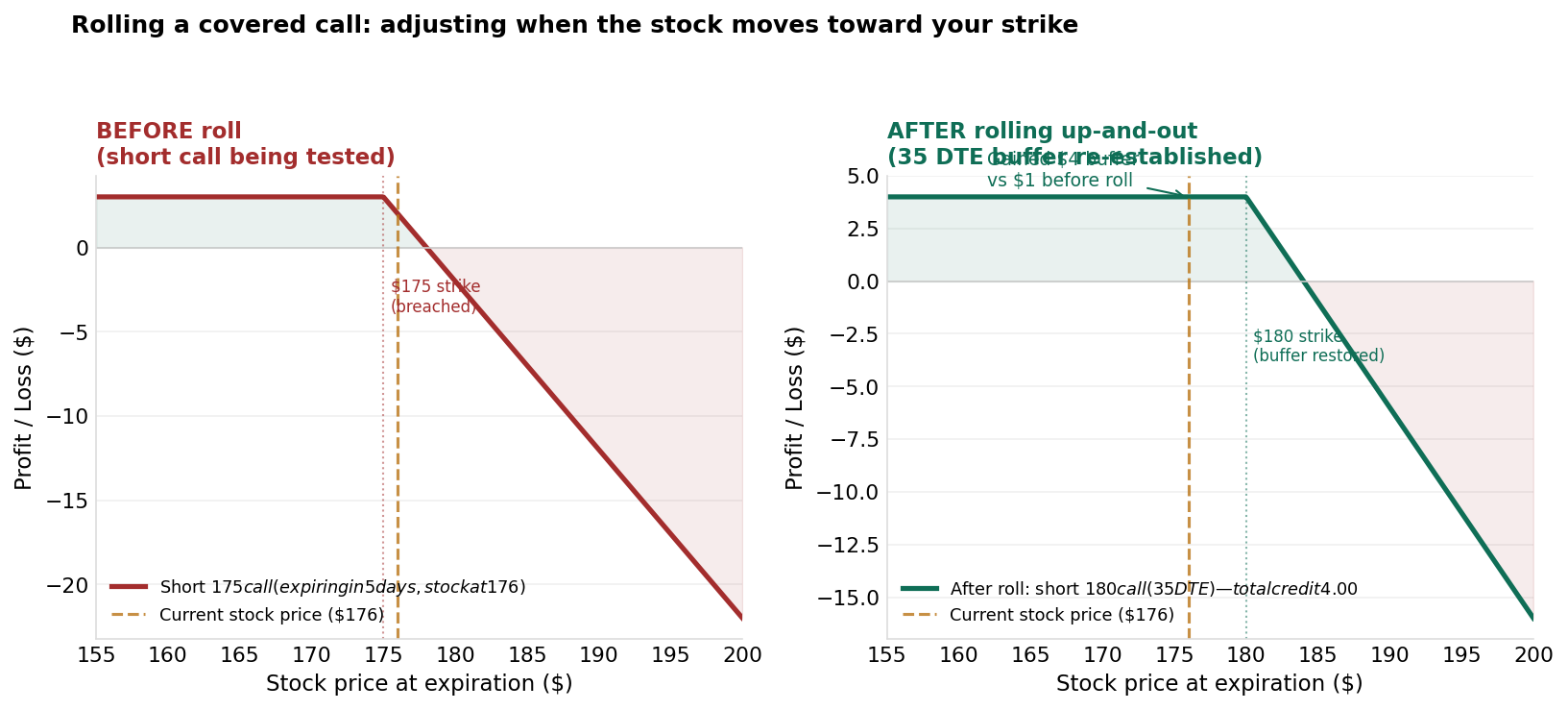 Before roll: short $175 call is being tested with stock at $176, only 5 days remaining. After rolling up-and-out to $180 for the next month, the buffer is restored and total credit collected increases to $4.00.
Result: You collect a net credit (next expiration’s higher premium offsets the cost of buying back the tested call), move your ceiling higher, and extend your time runway.
This is often achievable for no additional cost — or even a small credit — when rolling 30+ days forward. This is the ideal rolling scenario.
The Rolling Decision Framework
Not every position should be rolled. Here’s the hierarchy:
Step 1: Is the original thesis still intact? If the reason you entered the trade no longer holds — company fundamentals deteriorated, your technical level broke significantly, or the market environment changed — close the trade. Rolling a broken thesis just delays a loss.
Step 2: Can you roll for a credit? The best rolls collect additional premium. If you can close the threatened position and open the new one for a net credit, you’re earning money while buying time. This is the definition of a good roll.
If you can only roll for a small net debit (you pay to adjust), consider whether the extension is worth the additional cost. Typically: a small debit roll is acceptable if the new structure makes strong sense; a large debit roll is usually better replaced by simply closing.
Step 3: Are you inside 21 DTE? Rolling from inside 21 DTE typically means going to a near-term expiration where gamma risk is again elevated. Sometimes this is fine; often it’s better to close and start fresh in the next cycle with a full 30–45 DTE runway.
Step 4: Have you already rolled once? A single roll is a legitimate position management technique. Rolling twice or more on the same trade is often chasing a bad trade. Each additional roll locks in more premium received, but also extends your capital commitment. There’s a point where closing at a modest loss and redeploying is superior.
Rolling Credit Spreads
Rolling single options (covered calls, CSPs) is relatively clean. Rolling spreads is more complex because you’re managing four legs.
For an iron condor with the call side being tested:
Option A: Close the tested call spread only Buy back the short $175/$180 call spread. The put spread continues to run (or close it too for a full position closure). Accept the realized loss on the call spread.
Option B: Roll the tested spread out in time Close the $175/$180 call spread and reopen the same or a similar spread in the next expiration. This extends your time to be right.
Option C: Roll the untested put spread toward center (for additional credit) If the call side is being tested, roll the put spread from $160/$165 up to, say, $163/$168. This collects additional credit and narrows the overall condor — but increases put-side risk if the stock reverses hard.
General preference: Most experienced traders address only the tested side and leave the untested side alone unless there’s a specific reason to adjust it.
Rolling CSPs After Assignment
Sometimes you’re assigned shares on a cash-secured put — that’s not a failure, it’s the strategy working as designed. But occasionally you want to avoid assignment (perhaps the stock had a fundamental deterioration).
If a CSP is deep ITM with 3–5 DTE remaining and you absolutely don’t want assignment, you can roll it out:
- Buy back the ITM short put (at a loss over the original premium)
- Sell the same strike in the next expiration (collect more premium)
- If the new expiration premium > buyback cost, you collected a credit for extending
This only delays the potential assignment — it doesn’t eliminate it if the stock stays below the strike. Use this sparingly and only when you have genuine conviction the stock will recover.
When Rolling Is a Mistake
Rolling becomes counterproductive when:
You’re rolling to avoid accepting a loss, not because the position still makes sense. If you’ve lost $800 on a trade and the thesis is broken, rolling just commits more capital to a dead trade.
The roll generates only a tiny credit ($0.05–$0.10) that barely compensates for the extended risk exposure.
You’re adding a new directional bet when rolling. “Rolling up” a bull put spread when the stock is falling turns a range-bound trade into a more aggressive bullish bet. Know what you’re adding when you adjust.
You’ve exceeded your maximum planned loss. If you pre-defined “I’ll close this trade if it loses $500” and it’s at $500, close it. Rolling past a stop level is discipline failure.
Key Takeaways
- Rolling = closing an existing options position and opening a new one with different strike/expiration in a single order
- Three types: roll out (same strike, later expiration), roll up (higher strike), roll up-and-out (both — usually best for covered calls)
- Roll when: original thesis is intact, you can collect a credit (or small debit), and time remains before gamma risk peaks
- Close when: thesis is broken, max loss threshold is hit, or the roll only delays an inevitable loss
- Avoid rolling to avoid accepting a loss — that’s the most common rolling mistake
- For spreads: typically address only the tested side; leave the untested side running unless there’s a specific adjustment reason
What’s Next
Rolling is one tool in your position management kit. The broader skill — knowing when to hold, when to roll, and when to simply cut a loss — is the topic of Managing Losing Trades: The Rules That Protect Your Account.
Rolling is one of the most frequently used actions on Tastytrade — their platform has a dedicated roll order type that lets you close the expiring leg and open the new one in a single transaction, so you can extend or adjust positions in seconds without legging in manually.
Disclosure: this is a referral link. If you sign up via this link, the site may earn a commission at no cost to you.
Disclaimer: This content is for educational and informational purposes only and does not constitute financial, investment, or trading advice. Options trading involves significant risk and is not suitable for all investors. You may lose the entire amount invested. Always conduct your own research and consult a licensed financial advisor before making investment decisions.