Managing Losing Trades: The Rules That Protect Your Account
Managing Losing Trades: The Rules That Protect Your Account
Every professional trader has a story about the trade they held too long. Not because they didn’t know the rules — but because in the moment, it felt different. The stock was surely going to bounce. The thesis hadn’t changed. Closing now would just lock in a loss that might not have to happen.
That story ends the same way every time.
Managing losing trades is less about technical skill and more about pre-commitment: setting your rules before you enter the trade, when your thinking is clear, and then executing them mechanically when the trade goes against you, when your thinking is anything but clear.
Why Traders Hold Losers Too Long
The psychology of a losing trade is well-documented. Loss aversion — the tendency to feel losses roughly twice as acutely as equivalent gains — makes holding a loser feel preferable to realizing the loss. “It’s only a loss on paper” is the mantra. As long as you don’t close, you haven’t admitted you were wrong.
Options compound this problem in two ways:
Time is finite. Unlike stocks, options expire. A stock at a loss can sit in your portfolio for years while you wait for recovery. An option that’s deep ITM against you has a countdown timer. Every day you hold a losing option position hoping for reversal is a day closer to forced realization.
Gamma accelerates losses. As previously covered in Delta Explained, options near expiration develop high gamma. A short call spread that was manageable at $1.00 loss can become a $2.00 loss in a single session if the stock makes a sharp move near expiration.
The Loss Rules for Every Major Strategy
Rule 1: Credit spreads — close at 2× the credit received
If you sold a bull put spread for $1.50, set a hard close order at $3.00 (the point where you’ve paid 2× in premium to buy it back). This limits losses to twice the initial credit and prevents a position from blowing up.
Rationale: At 2× loss, the risk/reward profile has fundamentally deteriorated. You need the trade to recover significantly just to break even — and you’re consuming time and capital that could be redeployed into a fresh, properly-structured trade.
Rule 2: Short premium positions (naked or CSP) — close at 200% of credit
Similar to spreads: if you sold a put for $4.00 and the position has moved against you to a current cost to close of $12.00, close it. You’ve lost $800 — that’s 2× the $400 credit.
Rule 3: Long debit trades — close at 50% of premium paid
If you paid $3.50 for a bull call spread and it’s now worth $1.75 (50% loss), close it. This prevents a 100% loss from doubling a 50% one.
Rule 4: Calendars and diagonals — close at 50% of the initial debit
Same logic as long debit trades. A $1.80 calendar gets a stop at $0.90 remaining value.
Rule 5: Iron condors — address each spread independently
Don’t look at the condor P&L in aggregate. Each spread has its own 2× loss rule. If the call spread has lost 2× the credit received for that specific spread, close the call spread. Leave the put spread running if it’s profitable.
The Decision Flowchart
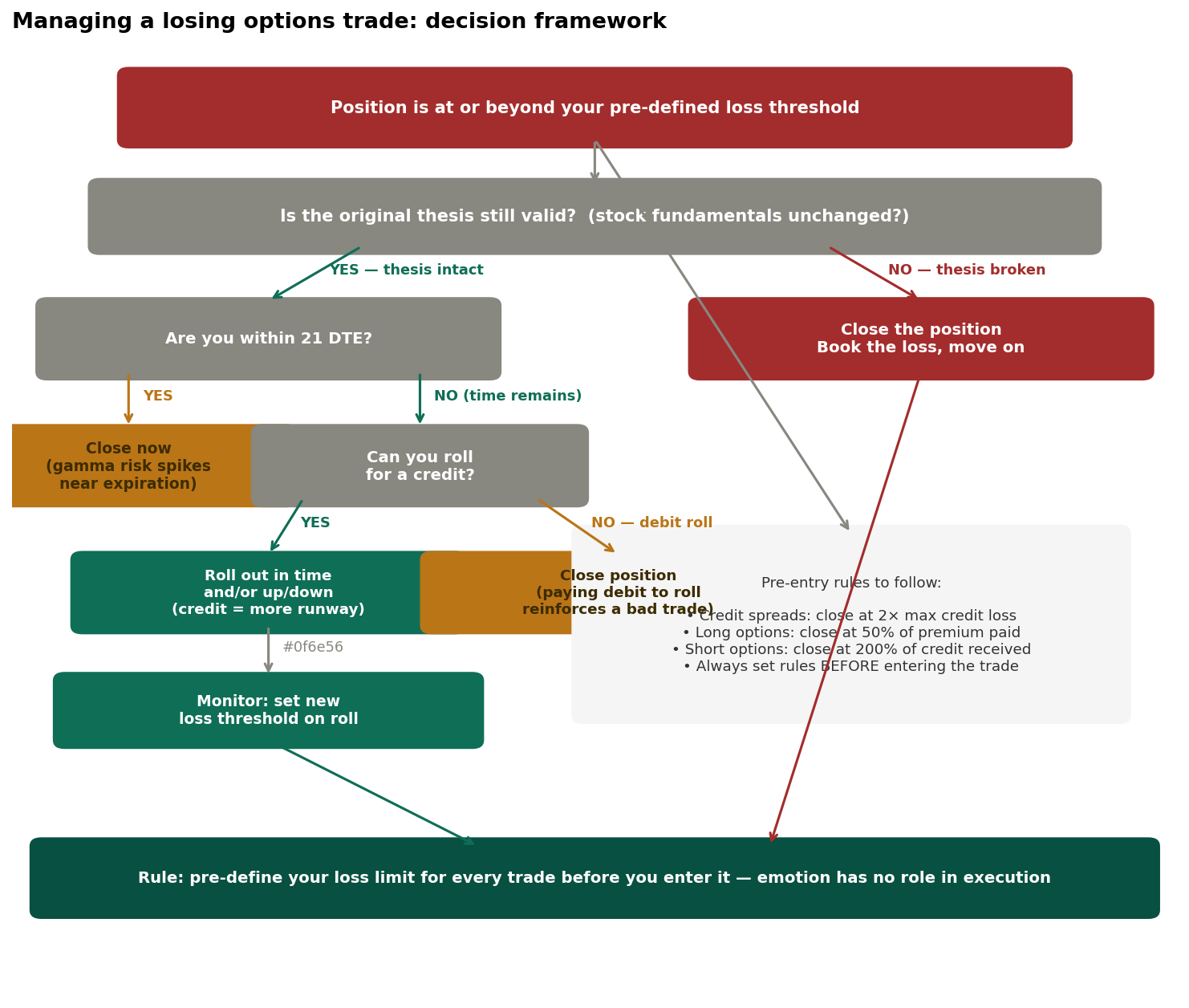 When a position hits its loss threshold, the first question is always thesis integrity. If the story has changed, close immediately. If not, rolling may be appropriate — but only if a credit is achievable and time remains.
The framework in plain English:
- Threshold hit? → Proceed to step 2
- Is the original thesis still valid? → If NO, close immediately. If YES, proceed to step 3
- Is expiration inside 21 DTE? → If YES, close (gamma risk spikes near expiry). If NO, proceed to step 4
- Can you roll for a credit? → If YES, roll out-and-adjust. If NO, close.
Every decision that results in “close” should be executed immediately, not revisited. Every decision that results in “roll” should be executed the same session, not delayed hoping for a recovery before you manage it.
Pre-Entry Trade Planning: The Only Real Solution
The rules above help, but the best management strategy is prevention: entering every trade with explicit, written exit rules defined in advance.
Before placing any options trade, answer these five questions and write down the answers:
- What is my profit target? (e.g., “Close at 50% of credit received”)
- What is my maximum loss? (e.g., “Close if loss reaches 2× credit”)
- What is my time stop? (e.g., “Close by 21 DTE regardless of P&L”)
- What will I do if the stock breaches my short strike? (e.g., “Roll up-and-out for credit, or close if no credit available”)
- What would change my thesis and force an immediate close? (e.g., “Earnings report misses, or stock breaks below key support”)
With these answers written, execution becomes mechanical. You don’t need to re-evaluate under pressure — you just execute the plan.
The Emotional Math of a Maximum Loss
Here’s a perspective shift that makes loss rules easier to follow:
Suppose you’re running a strategy that wins 70% of the time and you lose 2× your credit when you lose. Over 10 trades of $1.00 credit with a 2× loss limit ($2.00 max loss):
- 7 wins × $1.00 = $7.00
- 3 losses × $2.00 = $6.00
- Net: +$1.00
Now suppose you don’t follow the rule and let one losing trade run to 5× the credit (−$5.00):
- 7 wins × $1.00 = $7.00
- 2 losses × $2.00 = $4.00
- 1 loss × $5.00 = $5.00
- Net: −$2.00
Same strategy, same 70% win rate, completely different outcome. The one unmanaged loss turned a profitable system into a losing one. This is the math that makes loss rules non-negotiable.
What Not to Do: The Common Mistakes
“I’ll give it a few more days.” Options don’t care about your timeline. A few more days of the wrong move at high gamma wipes more value than the same few days gained in premium.
“Let me sell another option against it to reduce cost.” Adding legs to a losing position because you don’t want to close it is rationalization. Evaluate the new position on its own merits — would you enter it fresh with no prior context? If not, don’t add it.
“I’ll just turn it into a spread.” A popular move: you sold a naked put that’s gone ITM, so you buy a lower put to “create a spread” and limit further losses. This is fine if it creates a structure you’d actually want to own. It’s a mistake if you’re doing it to avoid booking a loss and the resulting spread has terrible risk/reward.
Checking P&L obsessively while holding a loser. Every check is an opportunity to talk yourself out of following your plan. Set a price alert for your loss threshold, stop watching the position, and let the alert tell you when to act.
Building a Rules-Based Trading Habit
The long-term goal is to make loss management automatic rather than emotional:
- Write your exit rules in a trade journal before entry — not after the stock moves
- Set alert orders at your loss threshold immediately after entering a trade
- Use GTC orders (Good Till Cancelled) to automate closing at target and stop levels
- Review every closed trade — did you follow your rules? If not, why? Pattern the exceptions
- Track your rule-following rate as a metric — it predicts long-term profitability better than win rate alone
Key Takeaways
- Pre-define exit rules for every trade before entering — when emotion is absent
- Credit spread loss limit: close at 2× the credit received per spread; long debit loss limit: 50% of debit paid
- Iron condors: evaluate each spread independently — don’t look at combined P&L to rationalize holding a losing side
- The decision hierarchy: Thesis broken? → Close. Inside 21 DTE? → Close. Roll for credit possible? → Roll. Otherwise → Close.
- One unmanaged catastrophic loss can erase months of consistent gains — the math makes loss rules non-optional
- Automate wherever possible: GTC orders, price alerts, and written pre-entry plans remove emotion from execution
What’s Next
You now have strategies and the risk management to execute them. The final piece of the system is how much capital to deploy on each: Position Sizing and Portfolio Risk: The Framework Pro Traders Use — the article that ties everything together into a coherent, scalable trading operation.
Managing losers requires fast, frictionless execution — exactly what Tastytrade is built for. Their platform lets you set profit and loss targets as working orders the moment you enter a trade, so your exits are already in place before a position ever needs active management.
Disclosure: this is a referral link. If you sign up via this link, the site may earn a commission at no cost to you.
Disclaimer: This content is for educational and informational purposes only and does not constitute financial, investment, or trading advice. Options trading involves significant risk and is not suitable for all investors. You may lose the entire amount invested. Always conduct your own research and consult a licensed financial advisor before making investment decisions.