Why Options Beat Stocks for Income Generation
The Income Gap Is Bigger Than You Think
Let’s look at where most investors park their money for “income”:
- The S&P 500 dividend yield hovers around 1.4% annually. That’s $1,400 on a $100,000 portfolio per year.
- A high-yield savings account might pay 4–5% — but that’s not investing, it’s parking cash.
- Bonds are paying 4–5% but come with their own duration and credit risks.
Compare that to what options traders collect by selling covered calls and cash-secured puts on stocks they already want to own: 10–16% annualized yields are realistic for consistent, disciplined traders. These yields reflect high-IV environments on quality underlyings; actual returns will vary significantly with market conditions, position management, and the IV environment at entry — and will be lower in flat or falling-IV markets.
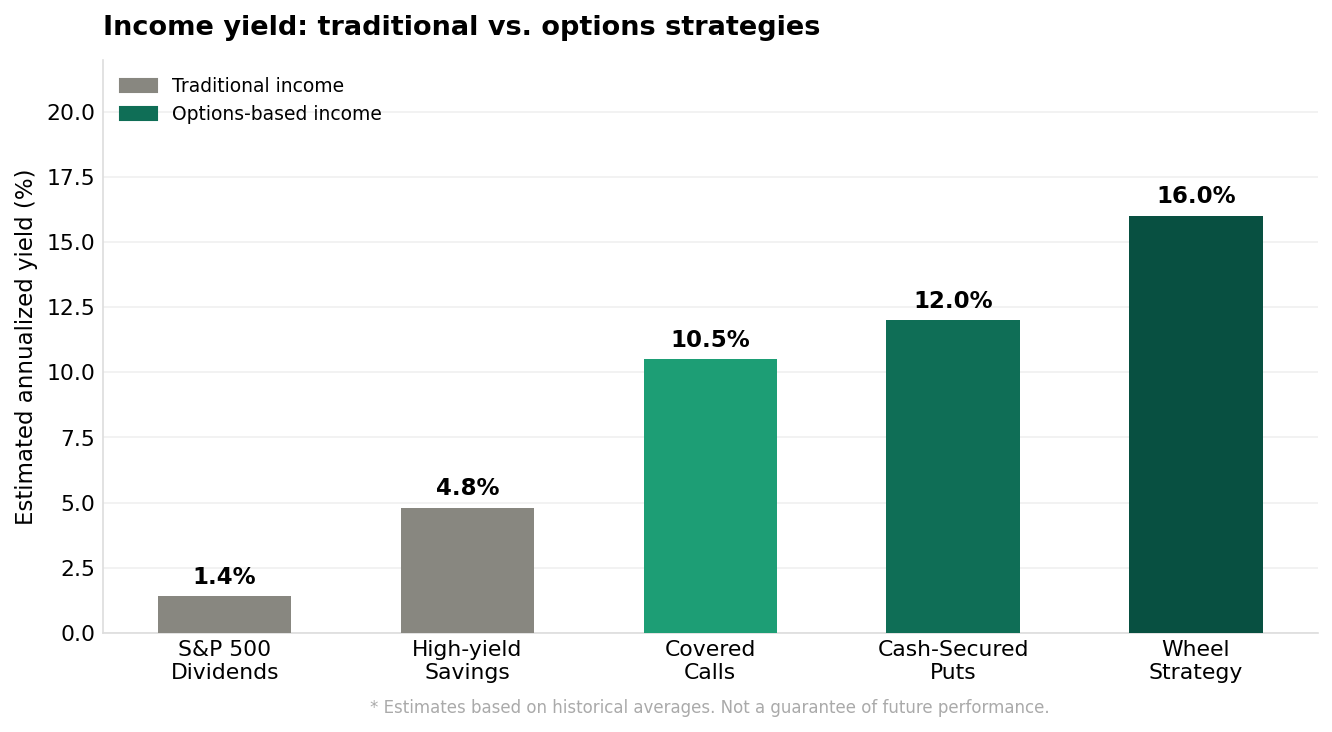 Estimated annualized yields. Options yield estimates assume consistent, disciplined premium selling on quality stocks. Past performance is not a guarantee of future results.
How Options Generate Income: Three Mechanisms
1. The Covered Call: Income from Stocks You Own
If you own 100 shares of a stock, you can sell someone else the right to buy your shares at a higher price. In exchange, they pay you a premium upfront — cash in your account today, regardless of what happens next.
If the stock stays below that price by expiration, you keep both the shares and the premium. Then you sell another call. Repeat monthly.
Example: Own 100 shares of AAPL at $170. Sell a $180 call expiring in 30 days for $5. That’s $500 in your account today. If AAPL stays below $180, you keep everything and do it again. Annualized, that’s roughly 35% annualized return on the per-share cost basis — or about $6,000/year in income on a $17,000 block of stock (100 shares × $170), if premiums hold and the stock is never called away. (Note: this assumes static monthly premiums at current IV levels, which is optimistic — actual returns will vary with market conditions.)
2. The Cash-Secured Put: Getting Paid to Buy at a Discount
Don’t own the stock yet? No problem. You can sell someone the right to sell their shares to you at a price you choose. You collect a premium for making that commitment. If the stock never falls to your price, you keep the cash and repeat.
If it does fall, you buy the shares at a discount to today’s price — which you wanted to do anyway.
This is less about speculation and more about getting paid to wait for the right entry price.
3. The Wheel: Combining Both for a Full Income Cycle
The wheel strategy chains covered calls and cash-secured puts together into a systematic income loop. We cover this in detail in The Wheel Strategy: A Full Income Cycle Explained, but the short version: sell puts until assigned, then sell calls until called away, then start again. Premium collected every step of the way.
Why Doesn’t Everyone Do This?
Fair question. A few reasons:
1. It takes some education. Options have their own vocabulary — strike prices, expiration dates, Greeks. The learning curve is real, but it’s not steep. A few weekends of study is enough to understand the basics.
2. It requires capital discipline. Unlike buying a stock and forgetting about it, options selling requires active management. You need to monitor positions and act when things move against you.
3. The risks are real. Options income is not free money. Selling covered calls caps your upside if the stock surges. Selling cash-secured puts means you could be forced to buy stock in a falling market. These are manageable risks, but they are risks.
Is Options Income Right for You?
Options income strategies work best for investors who:
- Have capital to deploy — you’ll need at least $5,000–$10,000 to trade meaningful position sizes
- Are patient and systematic — this is a slow, steady income game, not a get-rich-quick scheme
- Already invest in individual stocks or ETFs — options wrap around the equities you own or want to own
- Understand that income comes with tradeoffs — capped upside, assignment risk, and position management
If that sounds like you, this blog is your home base. We’ll cover every strategy from basic covered calls to advanced volatility plays — with real numbers, real examples, and no sugar-coating of the risks.
Key Takeaways
- Dividend investing yields ~1–2% annually; options selling strategies can realistically yield 10–16% on the same underlying stocks
- Three main income mechanisms: covered calls (own the stock), cash-secured puts (want to own it), and the wheel (combine both)
- Options income is not passive — it requires education, discipline, and active management
- The risks are real but manageable: capped upside, assignment risk, and ongoing position monitoring
What’s Next
Ready to go deeper? Here’s your path:
- Calls vs. Puts: The Plain-English Guide — understand the two sides of every options contract
- Your First Options Chain: How to Read It — decode the numbers and columns you’ll see on any brokerage platform
- The Covered Call: Generate Income from Stocks You Own — your first income trade, step by step
If you’re ready to start generating income with covered calls, cash-secured puts, and the wheel, Tastytrade is an options-first platform built specifically for income traders — with streamlined tools for selling premium, rolling positions, and tracking your P&L across the wheel cycle.
Disclosure: this is a referral link. If you sign up via this link, the site may earn a commission at no cost to you.
Disclaimer: This content is for educational and informational purposes only and does not constitute financial, investment, or trading advice. Options trading involves significant risk and is not suitable for all investors. You may lose the entire amount invested. Yields referenced are estimates based on historical conditions and are not a guarantee of future results. Always conduct your own research and consult a licensed financial advisor before making investment decisions.